As seen in






Over nineteen years the economics tutor who wrote the H1 and H2 TYS answer keys distilled what actually separates an A from a B into five key strategies: motivation, planning, content, exposure and excellence. The ETG method is those five turned into a programme you sit inside every week, so the A grade habits become your own. This page walks all five, in the open.
As seen in
Singapore A Level Economics is a writing under pressure exam, not a content test. Most students stuck at a B do not have a knowledge problem, they have an application and writing problem, and that is a different thing to fix. We map every grade to the skill that earns it, then the five strategies below close the exact gap that is costing you marks.
Firms and decisions, the diagrams, the market structures, the macro models. We do not train you to memorise model answers. We teach you to understand why things work, so the content holds up under any phrasing of the question. On its own, fully understood, this is still only worth a C.
Most students arrive hereYou can explain a concept to a friend and it makes sense, then you sit in front of an exam question and something breaks. The examiner writes "lacks rigour" and you do not know why. The content gap closed months ago. What is left is the writing gap, and that distance is where most B grade scripts quietly lose their marks.
Most students plateau hereThe paper rarely tests a concept in isolation, it grounds everything in the real world. Many students paste in a template evaluation and hope. Examiners can tell. We drill genuine judgement, weighing and prioritising under time pressure, the part that actually separates a B from an A.
Where the method takes youThe bottleneck for most students is not what they know, it is how they write and evaluate it under pressure. The five key strategies that follow are Mr Toh's own framework for moving up this ladder, one rung at a time, and the ETG programme is built to deliver each of them.
This is not a list of tips. It is the framework Mr Toh has taught for nearly two decades, the same one he sets out in his masterclass. Each strategy answers one question: what actually moves the grade, and how is the ETG programme built to deliver it. Read them in order, because they build on each other.
The switch that turns effort on, and the lessons that flip it.
A plan you cannot reasonably fail, issued as a booklet.
Learned backwards from model answers, by the TYS author.
One essay and one case study a week, marked, until A Levels.
The evaluation layer that turns a B into an A.
The masterclass in full: motivation, planning, content, exposure and excellence, in Mr Toh's own voice. The sections below turn each one into the part of the ETG programme that delivers it.
Either something has lit you up, or it has not. If it has not, the question is not how to force yourself to study, it is what would have to be true for you to want to. Mr Toh's own switch flipped when he walked around a university campus in J2 and decided he was going. So get specific about what you want: visit a campus, talk to someone in the career you are considering, look up what the life you imagine actually costs and what salary supports it. You will know the switch has flipped when your first thought on waking is what to study next, when you read past the textbook because you want to, and when the news starts connecting to the concepts on its own.
None of the signs of a flipped switch are signs of IQ. They are signs of investment. A motivated student is not the one at the desk the longest, it is the one who reads the news with an economist's eye and half rehearses the applied questions before they ever appear on a paper.
That is why motivation is the first strategy. Get it right and the other four become things you want to do rather than things you have to be made to do.
Mr Toh teaches Economics as a framework for reading the world, not a syllabus to be survived. Lessons ground every concept in real cases, from carbon taxes to housing prices, so the subject stays interesting and you stay invested.
Students say it plainly: the subject they expected to hate became the one they looked forward to. That shift is the switch, flipped, week after week.
A good revision plan is one you cannot reasonably fail, that still gets you where you need to go. Mr Toh built his fitness back the same way: run one loop, beat it by five seconds the next day, then add distance, until increments too small to fail added up to something that was not. Revision is the same. You work in blocks, one block is one day in one subject, and on any given day you know exactly what you are meant to be doing. And the plan protects a buffer: the last fourteen days before the exam are light recap and proper sleep, not heavy new revision. The buffer is not optional, it is what keeps you out of panic on the day.
Take your start date, subtract your first exam, then subtract the fourteen day buffer. Divide what is left across your subjects by weight: each H2 counts as 1, each H1 as 0.5. Then split each subject 25 percent content, 75 percent practice, which is the opposite of what most students do, and exactly why most students plateau.
And do not plan in strict sequence. Leave about a third of your content blocks unscheduled, because you do not know your real weaknesses until practice has found them.
You do not have to build this alone. ETG issues a week by week revision plan from now to the A Levels, with daily content checklists already mapped to the syllabus, in a printed revision booklet. The buffer is built in, the content and practice ratio is built in, and the room for late discovered weaknesses is built in.
The fastest way to understand the five strategies is to sit inside one lesson for two hours.
The most common form of revision is armchair learning: read the lecture notes, highlight, read again, feel productive, remember nothing, because nothing in the process made you recall or produce anything. The fix runs the other way. Start from the exam questions and the model answers, then reverse engineer the content you need. Open the TYS, pick a question, and if you cannot do it, look at the worked solution and ask which part you do not understand. That is your specific content gap. For revision, your primary material is not lecture notes, it is model essays and worked CSQ solutions, because they hold the theory, the structure and the evaluation together, in the order the examiner wants them.
Take any concept you believe you understand. Without your notes, write three paragraphs explaining it to an imagined friend, with the diagrams. Compare it to the model. If yours matches, your understanding is real. If it does not, what you have is the feeling of understanding, which is common, while demonstrable understanding is rarer. The exam tests the second one.
So content at ETG is never taught to be recited. It is taught to be produced, on paper, under the phrasing the examiner will actually use.
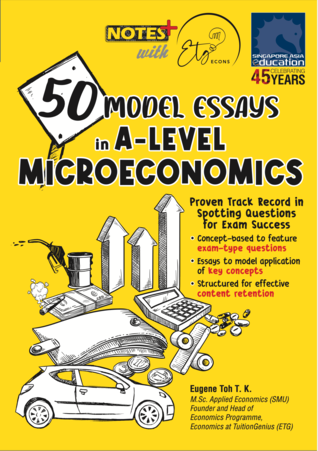
Your primary materials are model essays and worked TYS answers written by the economics tutor who wrote the H1 and H2 TYS answer keys, published by SAP and sold at Popular, and the 50 Model Essays (Shing Lee). When you reverse engineer content from a model answer here, you are reading from the same mind that defined it.
And the content loop is closed every week: you attempt a paper, it comes back personally marked, and you study the A grade version of your own question. Marking is included for every student, not a paid extra.

The content strategy runs on materials written by Mr Eugene Toh, ETG's founder and lead economics tutor, who wrote the H1 and H2 Economics TYS answer keys published by SAP and sold at Popular, and the 50 Model Essays series published by Shing Lee. He holds a B.A. in Economics from NUS and an M.Sc. in Applied Economics from SMU.
Every textbook, rubric and worked solution comes from the same hand, and is rewritten each term to the current syllabus and the latest SEAB trends. So when you study a model answer to reverse engineer the content you need, you are reading from the same mind that defined it, the same person who will mark your essay this week.

If you take one number from the whole framework, take this one. One essay and one case study, every week, from now until the A Levels. That is the floor, not the ceiling, and it builds toward roughly 100 essays and 100 case studies across the two years. A J2 below eighteen of each, or a J1 below ten, has a clear mechanical reason their results are not where they want them, and the reason is volume. The exam is, in functional terms, a writing exam dressed up as an Economics exam, and you cannot sit a piano grading having barely touched the keys.
Writing the essay is not the part that moves the needle, the comparison afterwards is. An essay is done only when you have written it, compared it to a strong model, identified the specific gap, and annotated what a better version looks like. Miss the last step and it does not count, so reset the counter. And never attempt an essay you have no strong model answer for, or you absorb your own mistakes as if they were correct.
Volume alone is not enough. You need range: across topics, across difficulty, RI, HCI and ACJC papers alongside the TYS itself, and across the many angles a single topic can be tested from.
The exposure benchmark is the spine of the weekly programme. You attempt one essay or case study a week in the exact exam format, it comes back personally marked with sentence level comments on what an examiner would credit and where the marks slipped, and you get a worked model plus a video walkthrough, so the comparison phase that actually counts is done for you, properly, every week.
Here is what makes that loop rare. At most centres, having your essays marked or your model answers explained is a separate paid lesson, if it is offered at all. At ETG the weekly graded practice is included for every student. We can run it as a standard feature because we are an Economics specialist, and teaching one subject at scale gives us the capacity to mark every student's work, every week.
The first four strategies get you to a B. The gap to an A lives in the last layer, excellence applied to each of the four. And the single biggest reason students do not get the A is evaluation. They have decent content, exposure and skills, but their evaluations are generic, or worse, they ask for "the evaluation" as if one correct answer lived on a list. It does not. Evaluation is specific to the answer you wrote, your judgement, backed by reasoning, on the limits and trade-offs of what you just argued. You learn it from Cambridge examiner reports, from strong model essays read critically, and from a daily news hook, for example Singapore's carbon tax, that grounds the judgement in the real world.
Build every body paragraph with four moves and the analysis and evaluation marks are structurally built in, rather than hoped for. Drop one and the paragraph reads thin, drop two and the examiner writes "lacks economic rigour".
The case study equivalent is DATE. In practice it is often cleanest to start from theory, identify the concept the question tests, then read the data with that lens, so you do not drown in the extract.
Every essay attempted, with the model answer compared and annotated alongside. By the A Levels, your most thumbed reference.
The same, for CSQs, so you can flip back and find the question types you keep losing marks on.
Every definition you must know, plus a page per problem concept you do not yet fully understand.
Useful statistics as ready examples, plus strong evaluations you have borrowed, tagged by topic.
A Raffles student once scored a B and was furious. Asked to redo one essay under timed conditions, she wrote eight pages and scored twenty four out of twenty five, then ran out of time and wrote one paragraph for the third essay. The two grade gap was not content and not writing, it was time.
You have about 45 minutes per essay, and the target for an A is roughly 19 to 21 of 25, not 24. Write what reaches the target on all three, then stop and move on. The excellence layer trains that discipline, not just the content.
Excellence is not a separate module, it is the standard held across motivation, planning, content and exposure. The four exercise books and the two writing frameworks are drilled in the weekly loop until they are automatic. Examiner aligned marking targets your evaluations specifically, not generically.
And it is sharpened by the prediction programme and the ETG Intelligence layer below, both built to focus the final weeks on the highest return work.
Each year Mr Toh reverse engineers the paper from more than twenty years of theme analysis, reviews every top JC prelim set within a week of release, and tracks how SEAB phrases its questions over time. That produces a predicted theme list, a prelim review, simulated papers under timed conditions, and a post exam debrief released within hours of each A Level paper.
A necessary caveat, every time. This is pattern reading, not prophecy. SEAB sets the paper, not us. The value is that you walk in having already practised the themes most likely to appear, so nothing on the page is unfamiliar.
The method is not three vendors stitched together. Mr Toh codes ETG's websites, designed its learning platform, and built ETG Intelligence into it: nineteen years of ETG's notes, worked Ten Year Series questions and answers, and exam methodology, organised so they actively power what every student learns.
It is also why the method keeps compounding. Each cohort feeds back into the intelligence layer, so the system gets sharper every year, and so do its recommendations for you. The teaching, the materials and the technology are one designed system, improved every term.
Never fell behind
"Mr Toh prepares us for exams more than we need to be, and the LMS meant I never fell behind."
Myra Sham ACJCWe would rather show you students than quote you a percentage. Real, verifiable grade jumps from students who ran exactly this method, in their own words.
"I scored an E in my mid years, but after going through intense and effective revision at ETG, I identified my gaps and worked on them, and scored an A at the A Levels."
Wing Ter Tan · Verified review"He helped me turn my econs result from a D to an A. His lessons are fun and interesting and he also gives us enough practice to do well."
Chian Hong · Verified review"Mr Toh's predictions on the A Level questions are usually spot on, and I improved from a C or D grade to an A."
Zack Goh · Verified review"As long as you are willing to put in the effort, you will improve tremendously with his guidance, as I did from a consistent E to my first A."
Glynis Lim · Verified review"He helped me jump from Ds and Es to an A for A Levels. Very understanding and patient, super caring too."
Jamie Ng · Verified review"I thought econs was going to be my worst subject, but now it is my best subject."
Gabrielle Goh · ACJCIndividual results, in the students' own words, not typical. SEAB sets the paper, not us. Read 500+ verified reviews →
A wall of real ETG students on camera, from across Singapore's JCs, describing the parts of the method that moved their grade.
"Many times I submitted scripts and received immediate feedback."
Anthea Lim HCI"What helped me most was the consistency, doing multiple essays and homework every week."
Zachary SJI"Anyone can understand difficult Economics concepts when Mr Toh explains them."
Ryan Ho HCI"The curriculum is so structured that every week we know we are on the right track."
Serra EJC"By the time you sit for A Levels, it is like muscle memory."
Tok Wei Yang JPJC"Mr Toh makes the lessons really enjoyable, and the predictions were spot on."
Bryan Chiang HCIMore on video and in writing on the student reviews page →
Put together, the ETG method is Mr Toh's five key strategies turned into a programme. Each part reinforces the others, run consistently until the A grade habits are yours.
Lessons that connect Economics to the real world, so the switch flips and you stay invested, not just present.
A week by week plan you cannot reasonably fail, with the buffer and the 25 / 75 split built in, issued as a printed booklet.
Learned backwards from model answers and worked TYS solutions written by the author of the answer keys, then closed in the marked loop.
One marked essay or case study every week toward 100 of each, with the worked model and video, plus the question bank and crashcourses.
The evaluation layer, the four exercise books, the 4E and DATE frameworks, time management, prediction and ETG Intelligence.
A companion masterclass: how to actually revise once you sit down, the practical follow on to the five strategies above.
You have read all five strategies. The only thing left is to sit inside them.
The ETG method is Mr Toh's five key strategies to excel at the A Levels, turned into a weekly programme. The five are motivation, planning, content, exposure and excellence. Motivation comes from lessons that connect Economics to the real world. Planning is a week by week plan, with a buffer and a 25 percent content to 75 percent practice split, issued as a printed revision booklet. Content is learned backwards from model answers written by the author of the H1 and H2 TYS answer keys. Exposure is one personally marked essay or case study every week toward 100 of each. Excellence is the evaluation layer, the 4E essay and DATE case frameworks, the four exercise books, time management, the prediction programme and the ETG Intelligence platform.
Usually because the content gap closed months ago and what is left is the writing and evaluation gap. A student who can explain a concept clearly still loses marks when the answer lacks structure, lacks rigour, or pastes in a generic evaluation an examiner can see through. A is an evaluation grade: it rewards genuine judgement, specific to the answer you wrote, not a list memorised in advance. The excellence strategy targets that exact gap with the writing frameworks, the four exercise books and weekly marked practice, rather than re-teaching content the student already knows.
It is the exposure strategy, and the single most important number in the framework. One essay and one case study, written and properly corrected, every week from now until the A Levels, building toward roughly 100 of each across the two years. The exam is, in functional terms, a writing exam, so volume with correction is what closes the gap. At ETG that benchmark is the spine of the weekly programme: you attempt a paper, it comes back personally marked with a worked model and a video, and the comparison phase that actually counts is built in.
The prediction programme sits inside the excellence strategy. We build a reverse engineered theme list from more than twenty years of paper analysis, review every top JC prelim set within a week, track how SEAB phrases its questions, then run simulated papers and a post exam debrief within hours. But this is pattern reading, not prophecy. SEAB sets the paper, not us. The value is that you walk in having already practised the most likely themes, so nothing on the page is unfamiliar.
We publish whole cohort figures rather than cherry picked top scorers. The most recent A-rate was 74 percent, self reported by students after results, so it carries the usual response and selection bias and is indicative rather than exact. A word on how we get these numbers. In earlier years we texted every student after results to ask how they did, and published the outcomes alongside a wall of fame naming the students who scored an A. These days we keep it lighter: students simply let us know, if they are comfortable, through our student Telegram channel. So the figure reflects only the students who choose to report, and both strong and weaker students may not, so treat it as indicative rather than exact. That is also why, in recent years, we lead with what students actually say, and with the quality of the programme, rather than a percentage. We never claim guarantees, and SEAB sets the paper, not us. That is why this page leads with the method itself and with what students actually say, rather than a percentage.
You have read the whole framework. The best way to judge it is to sit a real two hour lesson, same room, same material, same standard. Not a demo, not a sales pitch. Come and judge it on the work.
Questions first? Message the admin team on WhatsApp, or Mr Toh directly.